



Simone de Beauvoir & Jean Paul Sartre Were Pedophiles
September 7, 2026
"The administrative investigation confirms the philosopher's manipulative behavior. In June 1943, the Ministry of Education removes Beauvoir from her duties for conduct incompatible with the teaching profession."
The father of Existentialism and the mother of Feminism were Satanists.
by Auguste Bardamu
@AugusteBardamu
(henrymakow.com)
The mother of modern feminism used her authority as a teacher to seduce her young students and deliver them to Jean-Paul Sartre.
History has made Simone de Beauvoir the absolute icon of women's emancipation. The philosopher who taught women to free themselves from men's domination.
But behind the legend lies an unrelenting moral and sexual abuse of power.
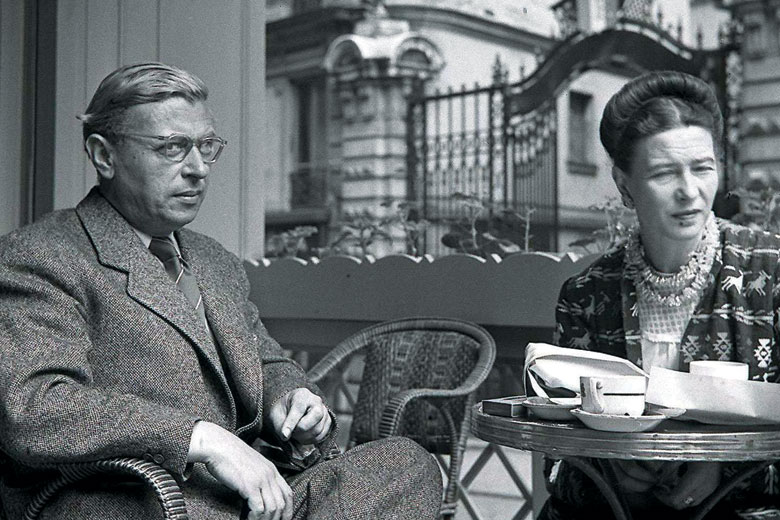
In the 1930s, Beauvoir taught philosophy. She targeted Bianca Bienenfeld in particular, a student who was only 16 years old. She began an intimate relationship with the teenager, psychologically isolated her, then introduced her into the bed of her partner, Jean-Paul Sartre.
The mechanism is destructive: Beauvoir seduces, Sartre consumes.
In their private correspondence published posthumously in 1990, the couple's cynicism turns the stomach. The young girls are dehumanized there, saddled with pseudonyms like Louise Védrine for Bianca.
Beauvoir writes in black and white the clinical management of her high school girls. She recounts to Sartre the nights spent with them, describing the naivety and submission of her students with the coldness of an entomologist.
In her letters, she openly revels in the total hold she exerts. She describes her prey in tears, sobbing with jealousy or anguish, all while coordinating the schedule with Sartre to pass them back and forth without one crossing paths with the other.

Sartre responds to her in the same icy tone, demanding intimate details or complaining about the emotional burden these young girls impose on them. The mythical couple manages the intimate lives of their students like a logistics contract, reducing these teenagers to the status of disposable toys.
Impunity wavers with the case of Nathalie Sorokine. In December 1941, the girl's mother files an official complaint against Beauvoir for corruption and endangerment of a minor.
The administrative investigation confirms the philosopher's manipulative behavior. In June 1943, the Ministry of Education removes Beauvoir from her duties for conduct incompatible with the teaching profession.
Her defenders systematically use the context of the Occupation to reduce this affair to a mere political persecution carried out by the Vichy regime. Beauvoir would even be formally reinstated upon Liberation in July 1945, though she never set foot in a high school again.
But the political screen of Vichy doesn't hold up.
The most damning evidence doesn't come from Pétainist archives. It comes from Simone de Beauvoir's own ink and from the memoirs published in 1993 by Bianca Bienenfeld, who would describe this hold as an absolute trauma.
The myth crumbles. The icon of progressivism consciously used her intellectual prestige to manipulate and destroy very young women for the sole benefit of her couple.
-
Note- The most direct first-person account is Bianca (née Bienenfeld) Lamblin's 1993 memoir .. Mémoires d'une jeune fille dérangée (English title: A Disgraceful Affair). Lamblin was one of Beauvoir's philosophy students at Lycée Molière; she describes a sexual relationship that began when she was 16-17, followed by Beauvoir introducing her to Sartre.
fr.wikipedia.org
Other books that document the same pattern with multiple students (Olga Kosakiewicz, Natalie Sorokine/Sorokin, and Lamblin) include:Carole Seymour-Jones, A Dangerous Liaison: Simone de Beauvoir and Jean-Paul Sartre (2008) Various later biographies and critical studies that draw on the published letters and the 1943 official complaint that led to Beauvoir's dismissal from teaching for "incitement of a minor to debauchery."
These sources treat the relationships as involving a clear teacher-student power imbalance and, in several cases, girls who were still minors at the time the relationships began. Beauvoir herself portrayed some of them as friendships or "contingent loves" in her own memoirs.






Anonymous said (September 7, 2026):
As a former college philosophy major, discovering the truth about Simone de Beauvoir and Jean-Paul Sartre leaves me in a state of absolute shock and disgust. In academia, philosophy is taught as if it exists in a sterile vacuum—completely cut, cleaned, and detached from the actual human beings who wrote it. We are never taught the real underpinnings of these thinkers' lives or how their personal pathologies shaped their theories.
It’s the exact same sanitized lie we were fed about Socrates—that I learned years later after college. Scholars love to frame his execution as a high-minded debate over abstract theology or political dissent, claiming he was sentenced to death for "impiety." But the "impiety" charge was just a respectable legal cover for the public outrage over what was actually happening: Socrates and his entire homosexual inner circle were engaged in the systemic exploitation and sexual grooming of young boys. Many modern classicists and historians emphasize that the idea of ancient Greece as a modern-style, openly "gay-friendly" society is largely a myth created by misinterpreting ancient texts through contemporary lenses. In reality, Athenian law heavily penalized passive adult homosexual behavior with the loss of civic rights (atimia), and using intellectual authority to prey on young students was viewed with deep anger, distrust, and disgust by the public. Yet modern education completely scrubs these predatory dynamics from the curriculum to protect the mythical narrative of the "great thinker."
This compartmentalization in education is a massive failure. You cannot separate a thinker’s philosophy from their underlying personal depravity, just as you cannot separate an addict’s daily choices from their addiction. Severe compulsions and perversity dominate a person's mind, fundamentally distorting how they view power, consent, and human worth. Philosopher Friedrich Nietzsche famously argued that every great philosophy is essentially "the personal confession of its author and a kind of involuntary and unconscious memoir."
Beauvoir and Sartre’s brand of existentialism—with its radical rejection of traditional morality—was never a noble pursuit of human freedom. It was a self-serving, post-hoc rationalization designed to give themselves ideological permission to sexually exploit and groom young people. Framing predatory behavior as "intellectual liberation" is a sick lie. When a philosopher’s private life is built on exploitation, that toxic core saturates their entire worldview. Academia needs to stop protecting these icons and start teaching the truth: their philosophy isn't a breakthrough, it’s the blueprint of their own sickness.